



Illuminance sensor

The HG-FHOLNS-001 fog signal and obstruction light aid-to-navigation system is independently developed by Haien Gebhard Electric Co., Ltd. and is configured for various offshore facilities such as fixed platforms, mobile platforms, single-point mooring systems, and artificial islands.It is a sound and light aid-to-navigation system for offshore facilities.At night or in low visibility conditions, the system provides warnings through specific light and sound signals.Both the navigation light and the fog signal use the Morse code "U" (“morse-u” signal).
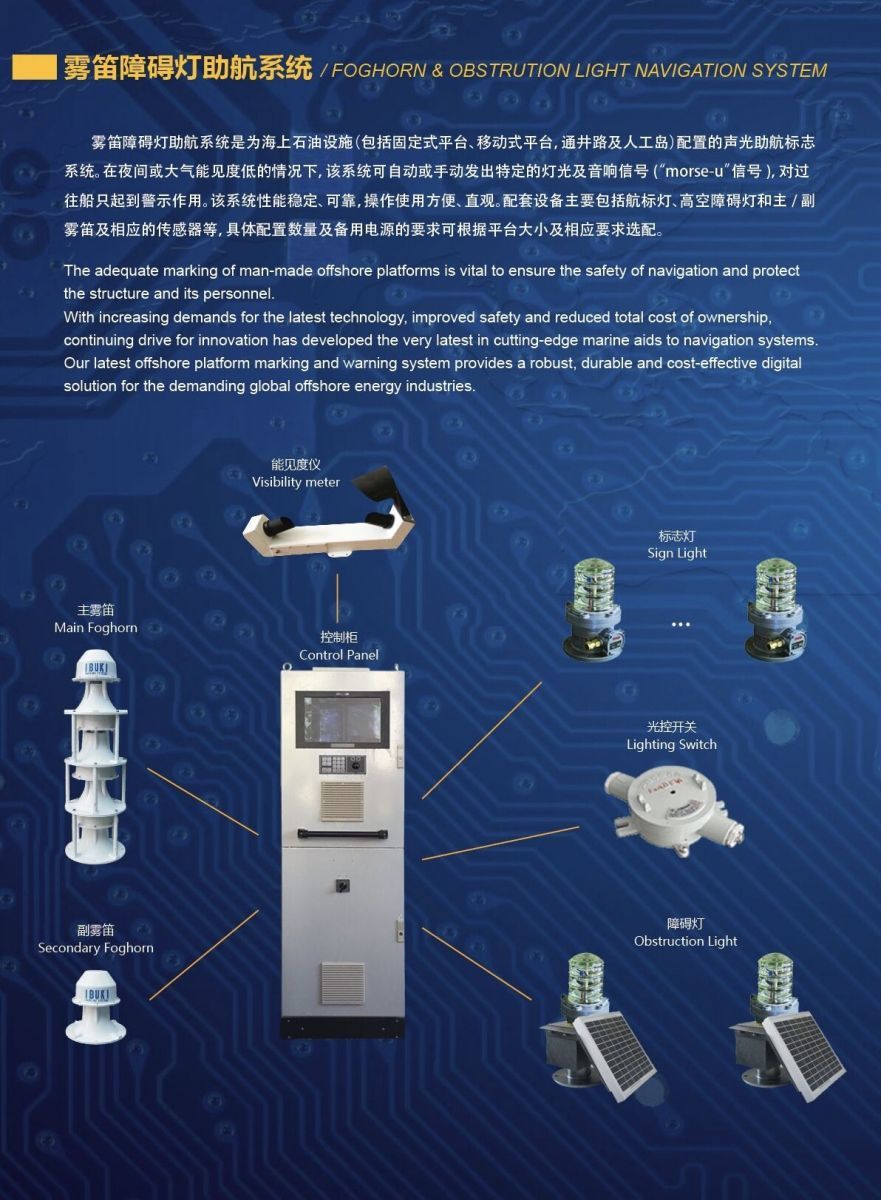
雾笛
The fog signal should be audible from any direction approaching vessels, at least 2 nautical miles; the installation height should be above the average high tide level, no less than 6m, and no higher than 30m; when the sea visibility is less than2n mile, the horn should automatically start sounding. The sound rhythm characteristics of the fog horn are Morse code "U" (·· —), with a maximum cycle of 30 seconds,
Technical Parameters
1. Operating Voltage: DC 24V
2. Rated Current: Main 8A/Auxiliary 1A
3. Effective Audible Range: Main 2 nautical miles/Auxiliary 0.5 nautical miles
4. Sound Intensity: 135dB
5. Frequency: 940HZ
6. Protection Level: IP56
7. Weight: 100kg
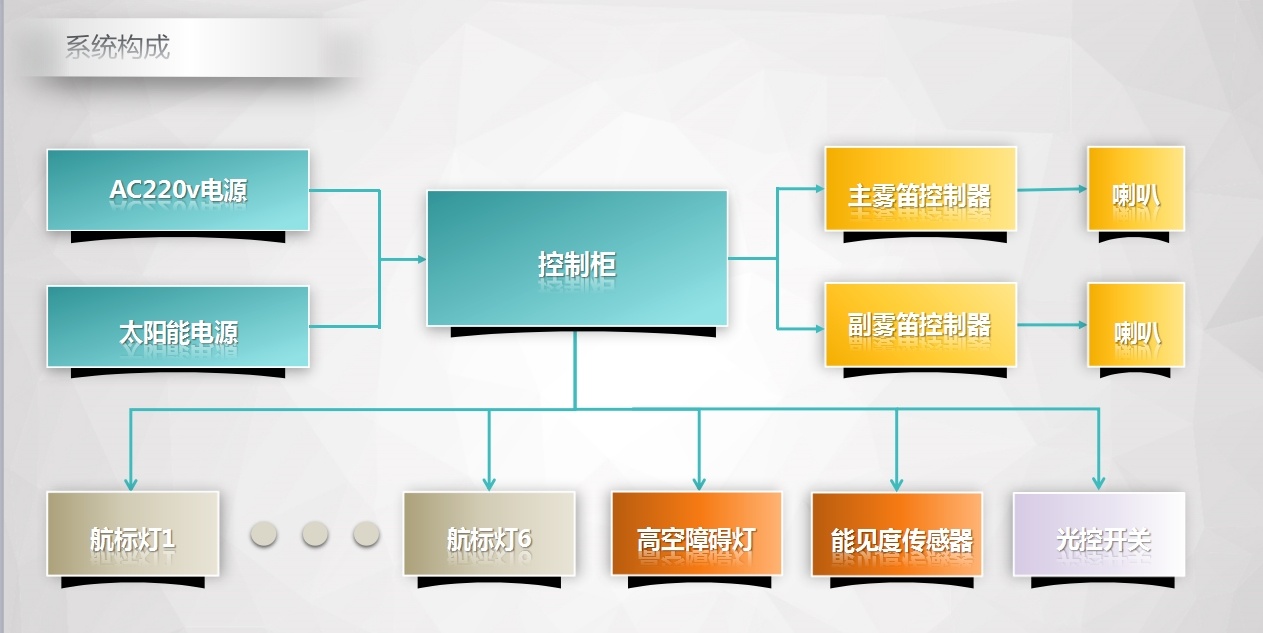
Control Cabinet
Model: CB-24
Includes:
1. Fog Horn Controller
2. Navigation Light Controller
3. Charging Device and Power Distribution Protection
Input 1: Main Power AC220V or Solar Charging Device DC24V
Input 2: Backup Battery (Capacity sufficient for 96 hours of operation)
Output 1: Main/Auxiliary Fog Horn, Navigation Light, High-Altitude Obstruction Light
Output 2: Visibility Sensor and Photoelectric Switch
Output 3: Fault Alarm Output. The control system within the control cabinet generates the internationally recognized "morse-u" signal required for the navigation light and fog horn:
Navigation Signal Light (T=12s):
Fog Signal (T=30s):
High-Altitude Obstruction Light Signal
High-Altitude Obstruction Light
Red obstruction lights should be installed at the horizontal and vertical end points of the platform.
1. Lamp Operating Voltage: DC:10.5V~13V
2. Daylight Switch: 0~400LX (Adjustable)
3. Light Range: >4.1 nautical miles (T=0.95)
4. Effective Luminous Intensity: 2500cd±25%
5. Ambient Temperature: -45℃~+50℃
6. Protection Level: IP56
7. Weight: 23kg
Navigation Light
Navigation lights should be installed around the platform. The structure and installation position of the lights should ensure that vessels approaching from any direction can see at least one light. The navigation lights should be installed at a height above the average high tide level,no less than 6m, and no higher than 30m; the minimum luminous intensity of the navigation light is 1400cd, and the vertical distribution of the emitted light beam should ensure visibility from near the platform to the maximum range of the light; the flashing characteristics of the navigation light are Morsecode "U" (·· —), with a maximum cycle of 15 seconds, its Morse code "U".
1. Operating Voltage: DC24V
2. Daylight Switch: 0~500LX (Adjustable)
3. Light Range: >4.1 nautical miles (T=0.95)
4. Effective Luminous Intensity: 2500cd±25%
5. Operating Environment: -40℃~+70 ℃
6. Protection Level: IP56
7. Weight: 4kg
Visibility Sensor
1. Range: 0-10km
2. Data Scan Cycle: 1min
3. Mean Time Between Failures: 20000 hours
Performance: Real-time monitoring of visibility values. When visibility is below 2 nautical miles, it provides a passive switch signal,providing a signal to automatically start the fog horn (the set value can be adjusted according to the actual situation).
4. Power Input: 9~36VDC, 6W
5. Ambient Temperature: -45℃~+50℃
6. Humidity: 0~100%
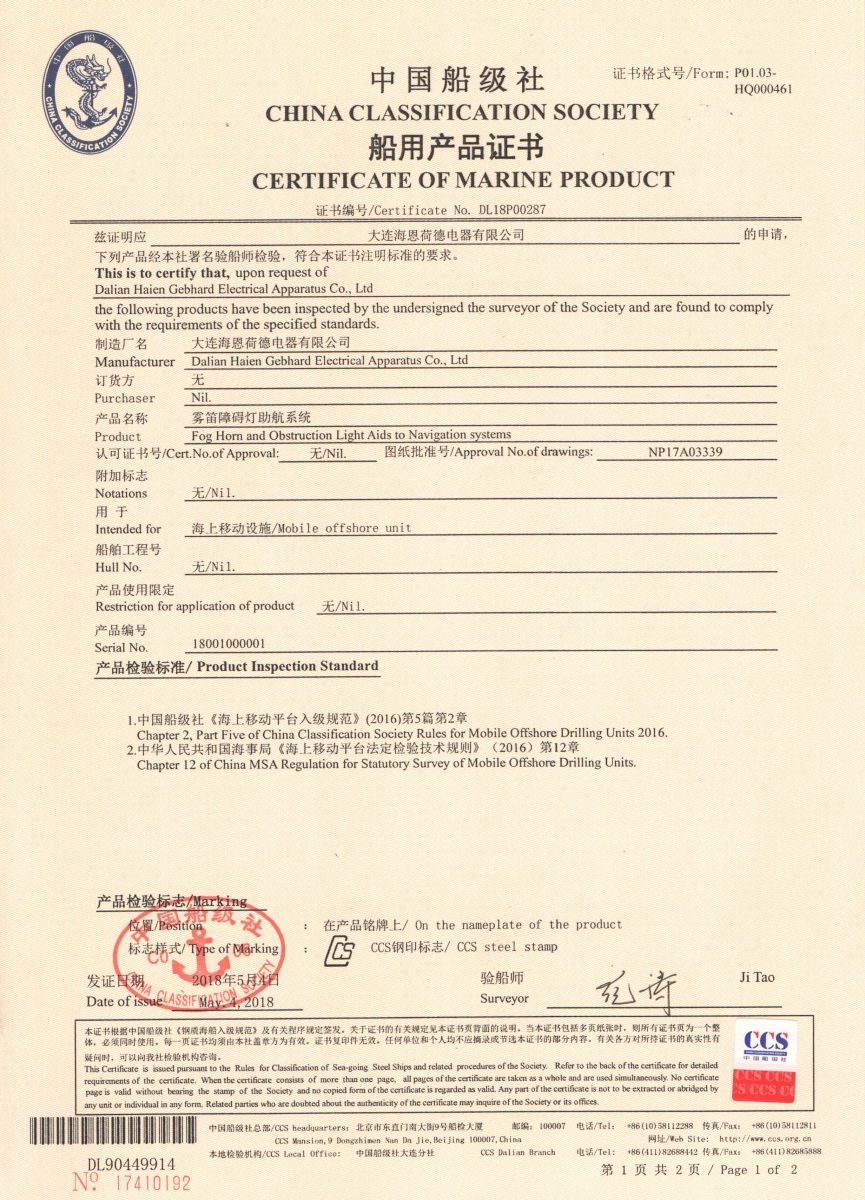
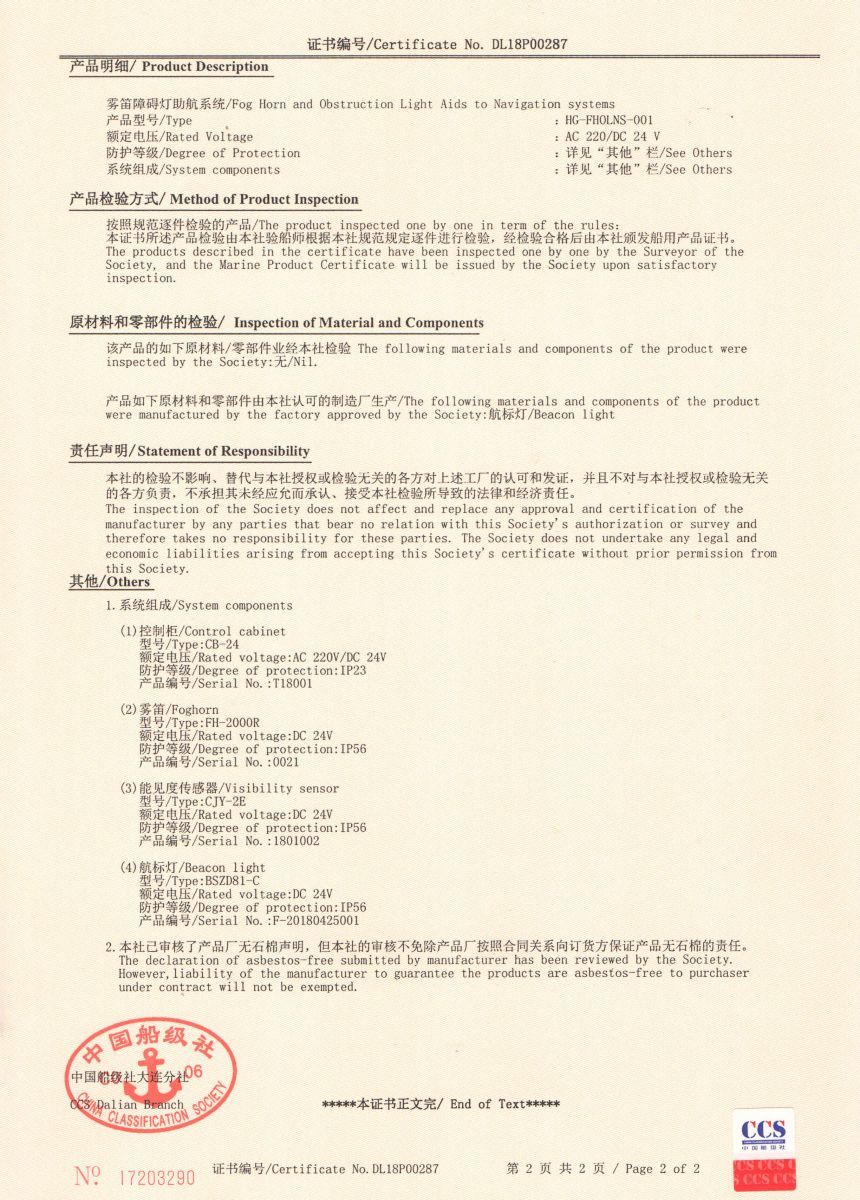
Our company successfully obtained the certification certificate issued by the China Classification Society (CCS) on May 4, 2018
Previous
Next
Previous
Next